
Scope of Service
Technical Capabilities
- Density – one of the fundamental physical properties;
- Color – the simplest indicator that allows to make first assumptions about the oil quality;
- Appearance of liquids – one of the first indications of possible changes;
- Kinematic and dynamic viscosity – proper hightemperature viscosity can ensure ideal effect of cooling and heat dispersion of transformer oil;
- Viscosity index – allows for a better comparison of the viscosity behavior of different oils based on temperature;
- Refractive index – allows you to calculate the hydrocarbon composition of the oils;
- Content of mechanical impurities – adversely affect the dielectric properties of insulating liquids;
- Flash point – indicates oil flammability and helps to prevent possible emergency situations;
- Breakdown voltage – ensures trouble-free operation of the entire transformer isolation system;
- Dielectric dissipation factor – indicates energy that is dissipated as heat in the presence of impurities;
Physicochemical characteristics:
- Dissolved gas analysis (DGA) – can provide insights into thermal and electrical stresses sustained by power transformers;
- Water content – even small amounts significantly reduce the breakdown voltage of the oil;
- Acidity – characterizes the degree of purification from naphthenic acids, which cause corrosion of equipment;
- Interfacial tension – checks whether there are soluble polar impurities in oil resulted from aging;
- Inhibitor (ionol) content – when the inhibitor content drops to 0.1%, the process of intensive aging of the oil begins;
- Sludge content – allows to identify the presence of deep aging products dissolved in oil;
- Water-soluble acids and bases – aggressive compounds that cause corrosion of metals;
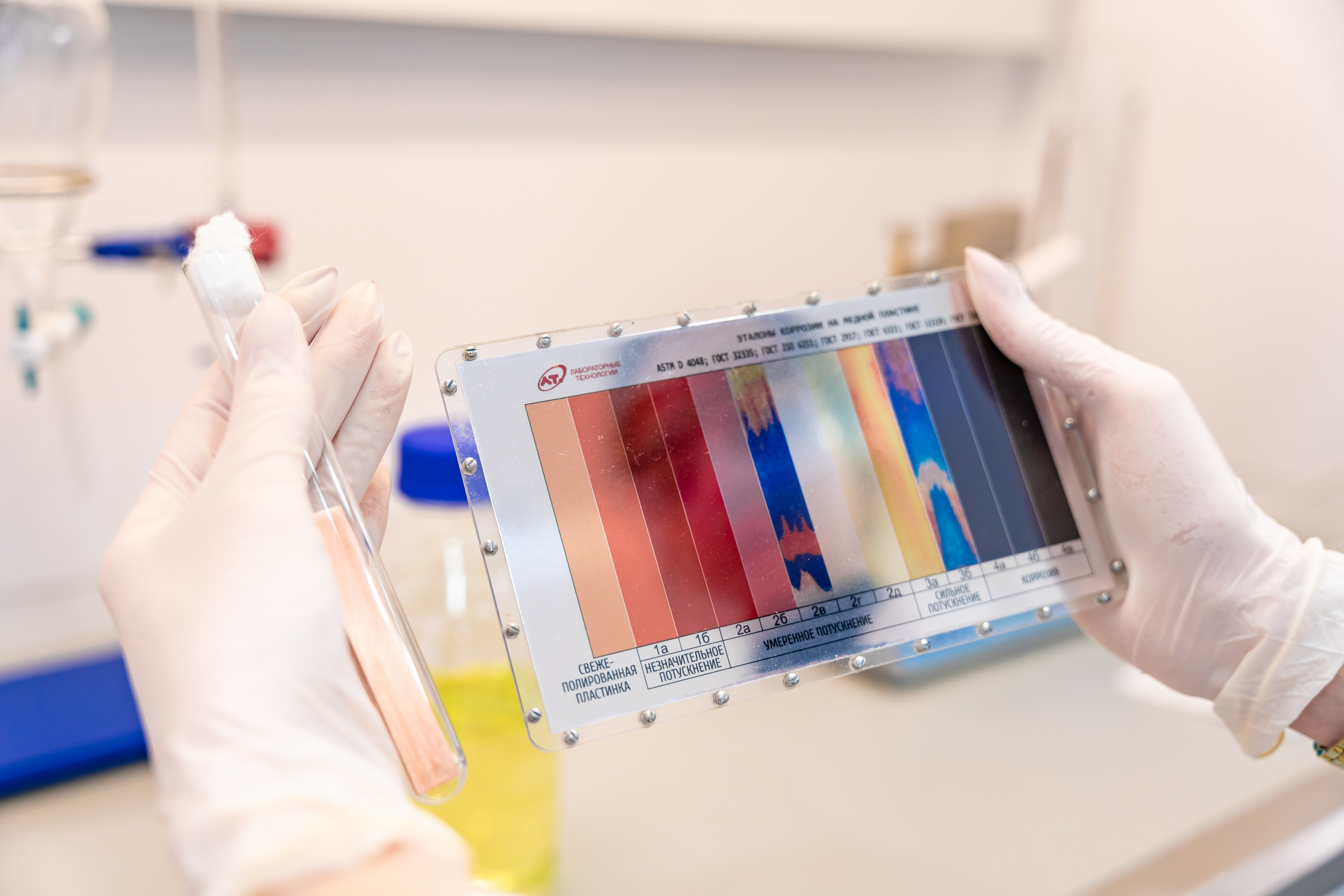
- Corrosive effects – leads to adverse effects on the internal parts of the equipment;
- Content of furan derivatives – provides information on the state of paper insulation;
- Carbon-type composition – the content of aromatic, paraffinic, naphthenic hydrocarbons;
- Determination of elements by inductively coupled plasma atomic emission spectrometry (ICP-AES) – the oil contains the metals because of their presence in the materials of the transformer components;
- Water separability – important performance characteristic;
- Average viscometric degree of polymerization of cellulosic materials – determines the useful life of the transformer, as the insulating paper loses its mechanical properties;
- Methanol and ethanol content – provides useful information for diagnostics and end-of-life transformer estimation;
- Sodium probe – characteristic of the presence of organic acids in transformer oil.





Execution & DeliveryResults and
Results and
documentation.
- Standard turnaround
- 3–5 business days for standard reports.
- Report format
- PDF report with findings, analysis, recommendations, and supporting documentation.
- Rush requests
- Confirm same-day or next-day express service availability with the team.
Methods & Standards
ASTM
Methodical approaches for accuracy and reliability.
ISO/IEC
International quality standards.
Quality Control
Verification at every stage of the process.
Your Technical InquiryLet's clarify
Contact Us